Portfolio item number 1
Short description of portfolio item number 1

Short description of portfolio item number 1
Short description of portfolio item number 2
Published:
This paper is about the number 1. The number 2 is left for future work.
Recommended citation: Your Name, You. (2009). "Paper Title Number 1." Journal 1. 1(1).
Download Paper | Download Slides
Published:
Hiring discrimination remains widespread in labor markets, raising questions about what workers can do to improve their chances of being considered for jobs in such settings. This paper examines whether soft skills are valued by employers and whether they can help mitigate discrimination. Using a correspondence study in Malaysia, we test the effects of signaling two soft skills: leadership and teamwork. We find that Malay and Indian sounding names are 11 and 14 percentage points less likely to be contacted, compared to Chinese sounding names. Soft skills are not explicitly demanded by employers, but signaling teamwork skills significantly reduces the discrimination gap in 43% and 33% for Malay and Indian candidates. We present a model that uses the soft skill signal to disentangle if the nature of discrimination is statistical or taste-based. Our results are consistent with statistical discrimination and highlight the potential of soft skills as a strategic signal to counteract hiring discrimination.
Published:
This paper is about fixing template issue #693.
Recommended citation: Your Name, You. (2024). "Paper Title Number 3." GitHub Journal of Bugs. 1(3).
Download Paper | Download Slides
Published:
The H-2A visa program was established to address labor shortages in U.S. agriculture by allowing farms to hire foreign temporary workers. Participating employers are required to pay both foreign and domestic workers performing comparable tasks a minimum hourly wage known as the Adverse Effect Wage Rate. This paper examines how increases in visa wages affect farms’ allocation of agricultural inputs. Using data from the USDA Census of Agriculture from 2002 to 2022, I implement a border-county pair design that compares counties across state lines. I find that a 1% increase in the visa wage leads to a 3.9% increase in the intensive margin of intermediate input use and a 1.1% increase on the extensive use. Higher visa wages also increase the value of machinery by 1.2%, consistent with labor-costinduced mechanization. The resulting input substitution contributes to higher agricultural productivity.
Peer pressure: Experimental Evidence from Restroom Behavior (with B. Cardinale Lagomarsino, M. Gutman, L. Freira, M. Lanzalot, M. Lauletta, L. Malchik, F. Montaño Campos, B. Pacini, and M. Rossi). Economic Inquiry, 55(3), 2017.
Download Paper
with Sarah Janzen, Yashodhan Ghorpade and Amanina Abdur Rahman (Submitted)
Hiring discrimination remains widespread, raising the question of how disadvantaged workers can improve their labor-market outcomes. Using a correspondence study in Malaysia, we test whether employers value two soft skills, leadership and teamwork, and whether signaling them mitigates discrimination. Applications with Malay and Indian names are 11–14 percentage points less likely to be contacted than those with Chinese names; we find no gender-based discrimination. Signaling teamwork reduces ethnic discrimination by 34–43%, while leadership has no effect. We develop a model using skill signals to distinguish taste-based from statistical discrimination. Our results indicate soft skills can counteract statistical discrimination. 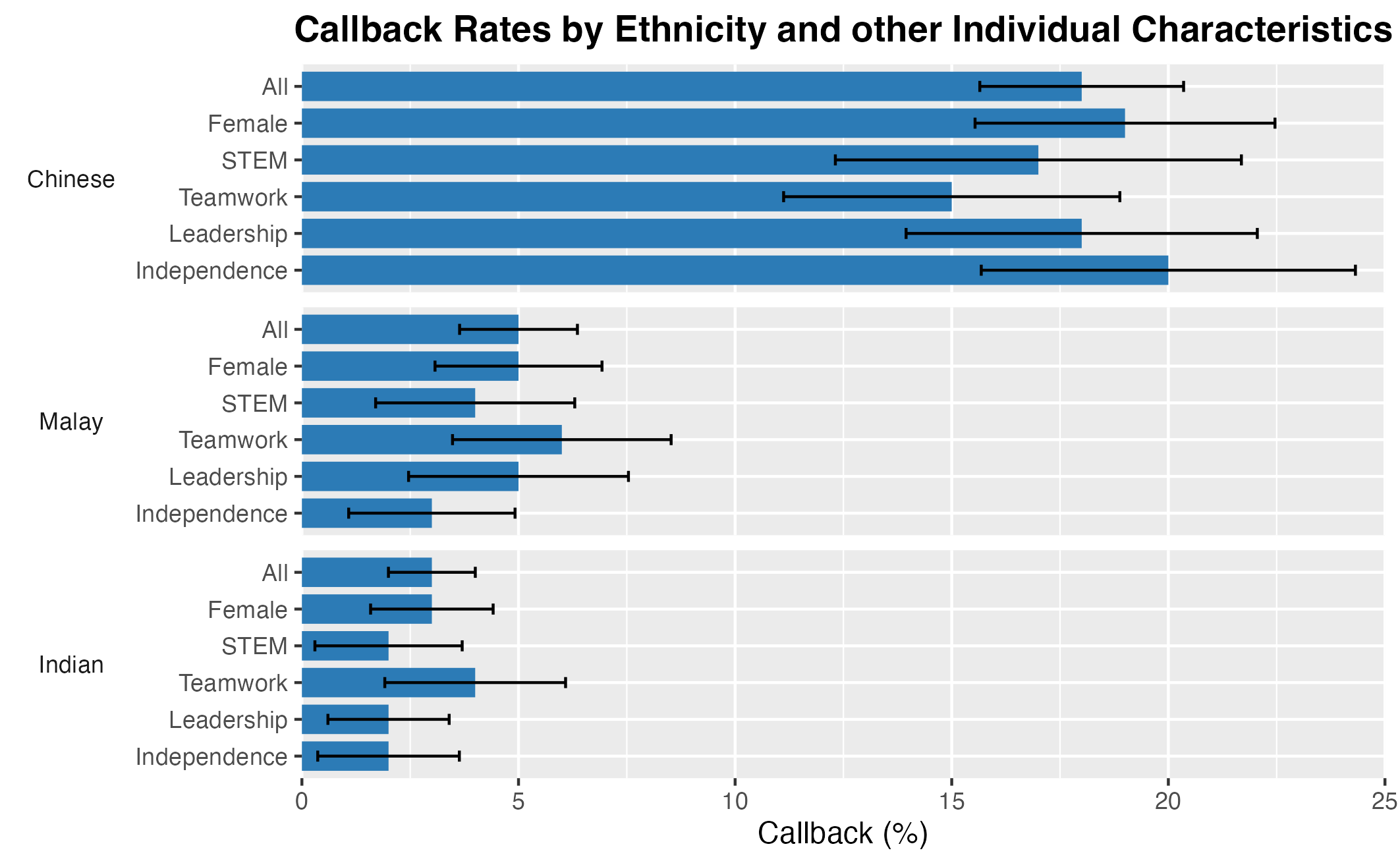
Recommended citation: Valencia, C., Janzen, S., Ghorpade, Y., & Rahman, A. (2026). Can a Soft Skill Signal Mitigate Hiring Discrimination? Evidence from Malaysia.
Download Paper | Download Slides
The H-2A visa program provides US farms access to foreign seasonal labor but requires employers to pay a federally mandated minimum hourly wage, the Adverse Effect Wage Rate, to both foreign and domestic workers performing comparable tasks. This paper studies how increases in the H-2A visa wage affect farms’ allocation of agricultural inputs. Using county-level data from the 2002–2022 USDA Census of Agriculture and a border-county pair design that compares counties across state lines, I show that higher visa wages lead farms to substitute away from labor and toward capital and materials. I find that a 1% increase in the visa wage on average leads to a 1.2% increase in machinery values, increases intermediate input use by 3.9% on the intensive margin, and expands the range of inputs used by 1.1% on the extensive margin. I find no effect on employment or payrolls. The results are consistent with labor-cost-driven mechanization and input intensification, which together contribute to higher agricultural productivity. 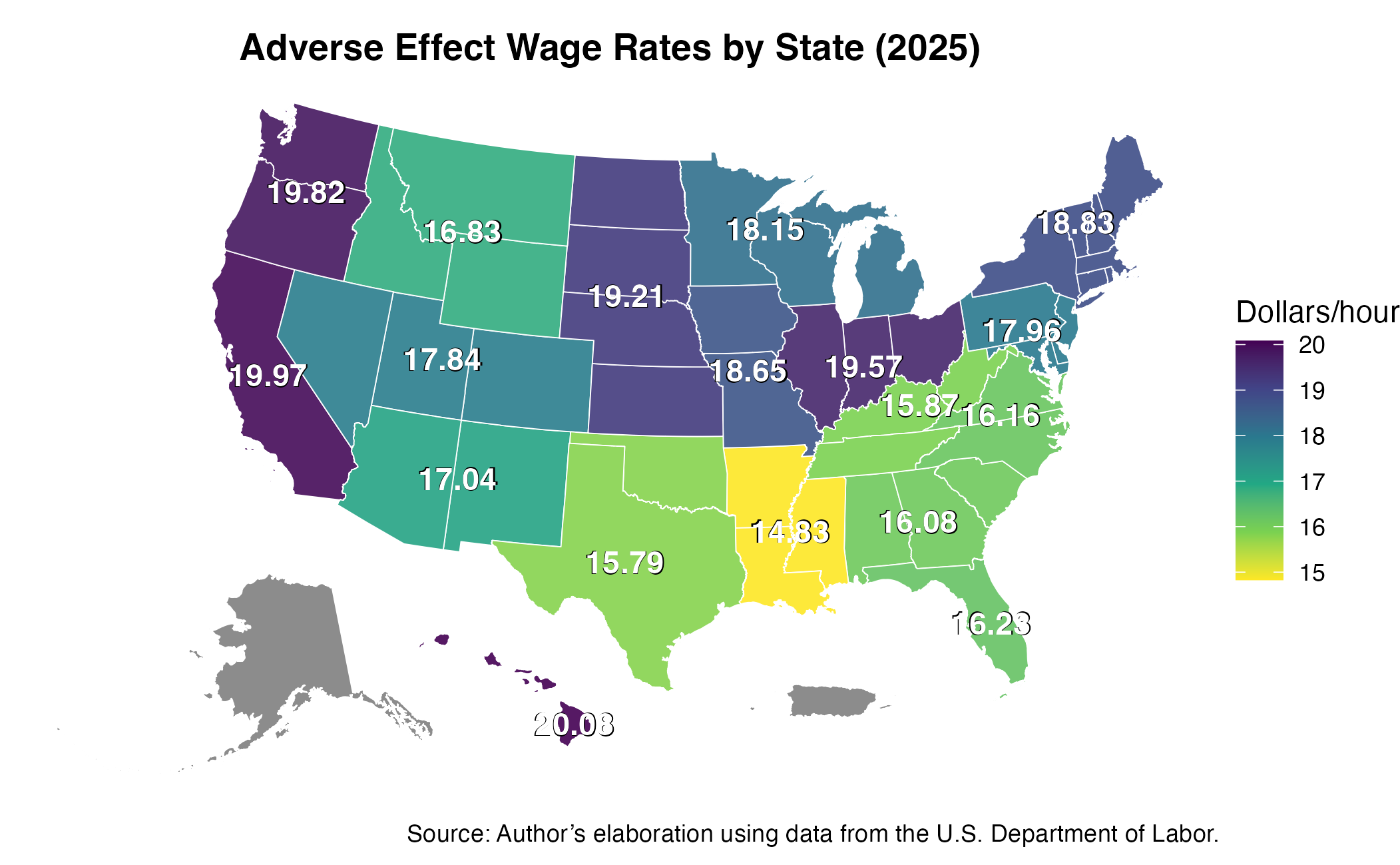
Recommended citation: Valencia, C. (2026). Visa Regulations, Agricultural Employment, and Productivity.
Download Paper | Download Slides
Diversity in Academia (with Anjali Adukia, Elisa Xi Chen, Anna Gifty Opoku-Agyeman, and Marieke Kleemans)
From Metro Lines to Market Values: A Case Study of Rail Expansion and Land Prices in Buenos Aires (with Sebastien Box-Cuillard and Gustavo Nino)
How Do Land Use and Crop Choices Respond to Labor Costs? (with Samyam Shrestha)
Access to Agricultural Workers and Crop Insurance
Published:
This is a description of your talk, which is a markdown file that can be all markdown-ified like any other post. Yay markdown!
Published:
This is a description of your conference proceedings talk, note the different field in type. You can put anything in this field.
Undegraduate and Masters courses, University of Illinois at Urbana-Champaign, 2024
Undergraduate course, University of Illinois at Urbana-Champaign, 2025